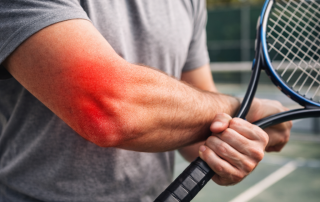
Elbow pain from gripping is a common issue that affects people during everyday activities like lifting groceries, opening jars, using tools, typing, or exercising. This type of pain is often linked to tennis elbow or golfer’s elbow and tends to flare up during routine movements rather than intense effort.
Many people rest for a few days, feel temporary relief, then notice the pain return as soon as they resume normal tasks. This usually happens because the same irritating movements continue to stress already sensitive tendons, even if the overall workload feels light.
This guide explains why elbow pain from gripping occurs, which movements keep it active, and what you can do to reduce irritation and support long-term recovery.
Tennis Elbow vs Golfer’s Elbow
Tennis elbow typically causes pain on the outside of the elbow and is associated with wrist extension combined with gripping. Golfer’s elbow usually causes pain on the inside of the elbow and is linked to wrist flexion and gripping.
Both conditions involve irritation of the forearm tendons where they attach at the elbow. While the pain location differs, the underlying issue is often similar: repeated stress without enough recovery.
If you’ve got elbow pain from gripping—opening jars, carrying groceries, lifting weights, swinging a club, using tools—there’s a good chance you’re repeatedly hitting the same few “irritation patterns” without realizing it.
In our Arvada clinic, we see a common story:
You rest for a few days, feel a little better… then one normal task (a heavy pan, a suitcase, a screwdriver) flares it right back up.
This post breaks down the 3 movements that most often keep aggravating tennis elbow or golfer’s elbow, plus practical modifications and a simple plan to calm it down and rebuild strength.
Quick takeaway: Most persistent cases aren’t from “one bad stretch.” They’re from repeating a high-load grip with the wrist/forearm in a position that overloads irritated tendons, day after day.
Tennis elbow vs. golfer’s elbow (simple difference)
Both are common overuse pain patterns around the elbow:
- Tennis elbow (lateral elbow pain): typically sore on the outside of the elbow. Often related to the muscles/tendons that help extend the wrist and stabilize grip.
- Golfer’s elbow (medial elbow pain): typically sore on the inside of the elbow. Often related to the muscles/tendons that help flex the wrist and assist grip.
You don’t need a perfect label to start improving it—but knowing which side hurts helps you spot which movements are poking the bear.
Why gripping can hurt so much
Grip is sneaky: even “light” tasks can create big tendon load when you combine:
- Tight grip (white-knuckle hold)
- Awkward wrist angle (bent up or down)
- Forearm rotation (twisting, pronation/supination)
- Repetition (lots of small bouts all day)
That combo can keep irritated tissue stuck in a loop.

The 3 movements that keep irritating it
1) The “death grip” with a bent wrist (especially wrist extended)
What it looks like:
- Carrying groceries or a tool box with the wrist cocked back
- Heavy farmer carries, deadlifts, pull-ups, rows
- Holding a heavy pan, suitcase, or kid carrier
- Using pliers/clippers with a hard squeeze
Why it keeps flaring elbow pain from gripping:
When you grip hard, the forearm muscles fire to stabilize the wrist. If your wrist is bent back (extension) while gripping, the outside-of-elbow structures (often linked with tennis elbow symptoms) can take repeated stress.
Try this instead (immediate changes):
- Neutral wrist rule: keep the wrist straight—imagine a line from knuckles to forearm.
- Reduce grip intensity by 20–30% (most people grip way harder than necessary).
- Use two hands for heavier objects temporarily.
- Change handle size: thicker grips can reduce strain for many people (rackets, bars, tools).
Mini-check: If you feel it most when carrying bags or lifting with the palm facing down, this pattern is a usual suspect.
2) Repetitive twisting while gripping (screwdriver, jar lids, wringing)
What it looks like:
- Opening stubborn jars/bottles
- Using a screwdriver, drill, or ratchet repeatedly
- Wringing out a towel, twisting wet clothes
- Yardwork that involves constant twist + squeeze
Why it keeps flaring:
Twisting adds forearm rotation on top of grip. That’s a double-load: the tendons help control the wrist while the forearm rotates. If the tissue is already irritated, frequent twist-grip tasks can keep it sensitized.
Try this instead (joint-saving swaps):
- Use a jar opener or rubber grip pad (seriously—low effort, big payoff).
- Switch to a power tool when possible (less repetitive torque).
- For towels/clothes: squeeze/press instead of wring, or wring using both hands with elbows closer to your sides.
- Break tasks into micro-sets: 2–3 minutes of work, 30–60 seconds rest, repeat.
Pro tip: If you can’t avoid twisting, reduce grip force first. Less squeeze = less tendon demand.
3) Gripping + “wrist flicking” (fast reps, impact, or poor mechanics)
What it looks like:
- Tennis backhand, pickleball, or golf swings where the wrist does the work
- Hammering or impact tools
- Repetitive mouse/trackpad use with a tense forearm
- High-rep curls, kettlebell work, or CrossFit-style volume when form slips
Why it keeps flaring:
Fast repetition or impact can load the tendon before it’s ready—especially if you compensate by “flicking” the wrist rather than using the shoulder/scapular muscles and trunk to generate force.
Try this instead (keep activity, lower irritation):
- Slow it down: cut speed and reps by ~30–50% for 1–2 weeks.
- Use your shoulder/trunk: think “move from the body, not from the wrist.”
- For racquet sports: consider string tension/grip size tweaks and a short technique reset.
- For gym lifts: reduce load, keep neutral wrist, avoid high-rep failure sets for now.
If you golf or play pickleball in Arvada: you don’t have to quit. You just need a short “deload + rebuild” block so your elbow stops getting poked every session.
What to do this week: a simple 3-step plan
Step 1: Stop feeding the flare (without “doing nothing”)
For 7–14 days, aim to reduce the top triggers above by about 30–50%:
- Lighter loads
- Less twisting
- Neutral wrist
- Less death-grip intensity
You’re not trying to become fragile—you’re trying to give the tendon a break from the exact pattern that irritates it.
Step 2: Use pain-calming strength (isometrics)
Isometrics are “hold” contractions that can be tendon-friendly.
Pick the side that matches your symptoms:
- Outside elbow pain (tennis elbow pattern):
Rest forearm on a table, hand off the edge. Gently lift the back of the hand up into resistance and hold 20–30 seconds, 4–6 rounds. - Inside elbow pain (golfer’s elbow pattern):
Same setup, but gently bend the palm up into resistance and hold 20–30 seconds, 4–6 rounds.
Rules:
- Mild discomfort is okay (think 0–3/10), sharp pain is not.
- Do it once daily for a week, then reassess.
Step 3: Progress to slow lowering (eccentrics) 3–4x/week
Once daily tasks are less spicy:
- Add slow wrist lowering with a light dumbbell (or a soup can).
- 3 sets of 8–12, slow 3–4 second lower.
- Keep the wrist neutral and the movement controlled.
This is often the bridge from “it keeps coming back” to “I can grip normally again.”
Common mistakes that prolong elbow pain from gripping
- Stretching aggressively into pain (can irritate more than help early on)
- Resting completely for weeks (the tendon deconditions)
- Only treating the elbow while ignoring shoulder/scapular strength and wrist mechanics
- Returning to full volume too fast (“I felt okay yesterday, so I did everything today”)
When you should get checked (especially if it’s not improving)
Consider a visit with a physical therapist if:
- Symptoms persist beyond 2–4 weeks despite smart modifications
- Pain is affecting sleep or daily function
- Grip weakness is progressing
- You’re getting frequent flare-ups with normal tasks
Seek urgent care if you have: sudden severe pain after a pop, major swelling/bruising, deformity, fever/redness, or significant numbness/weakness.
How physical therapy can help (what we actually look at)
A good plan usually includes:
- Identifying your top 1–2 trigger movements
- Adjusting grip/wrist mechanics for your sport or job
- Gradual tendon loading (isometrics → eccentrics → functional grip)
- Addressing upstream contributors (shoulder blade control, posture, neck referral patterns)
- Manual therapy and (when appropriate) modalities to reduce sensitivity
If you’re in Arvada, CO, a hands-on evaluation can help you stop guessing and get a clear progression.
FAQ
Why does my elbow hurt when I grip?
Grip loads the forearm tendons that stabilize your wrist. When grip is combined with twisting or a bent
wrist—especially repeatedly—it can irritate tendon tissue and keep it sensitive.
Do I need to stop lifting or playing tennis/golf?
Not always. Many people do better with a temporary deload and specific strengthening, rather than full
rest. The goal is to keep you active while reducing the movements that trigger symptoms.
Do elbow straps work?
They can reduce symptoms for some people during activity by changing load distribution, but they
usually work best as a short-term helper—not a standalone fix.
How long does tennis elbow or golfer’s elbow take to improve?
It varies. Many mild-to-moderate cases improve over 6–12 weeks with the right loading plan and trigger
modifications. Persistent cases may take longer, especially if the aggravating movements continue daily.