If burning, tingling, radiating pain, headaches, or unexplained mobility limits keep returning, the problem may involve more than tight muscles or stiff joints. Nerves also need to move. When a nerve becomes irritated or restricted by surrounding fascia, scar tissue, muscle tension, joint stiffness, or past injury, movement can feel sharp, guarded, sensitive, or unpredictable.
Neural manipulation is a gentle hands-on manual therapy approach that looks at how nerves move through the tissues around them. At Manual Therapy Associates in Arvada, this type of care may be considered when a person has nerve-related symptoms such as sciatica-like leg pain, arm or hand tingling, neck pain after whiplash, headaches connected to neck tension, or persistent pain that has not responded fully to standard care.
The goal is not to force the body. The goal is to assess the whole person, find areas where nerve mobility and tissue glide may be limited, and use precise, comfortable manual therapy to help the nervous system and surrounding tissues move with less irritation.
This guide explains what neural manipulation is, how it differs from general massage or forceful manipulation, who may benefit, what to expect during a session, possible side effects, and how to know when you should seek medical care first.
Call or text Manual Therapy Associates in Arvada at 303-668-2898 or use the Schedule Now button on the website if you want to discuss whether neural manipulation is appropriate for your symptoms.
Quick answer: What is neural manipulation?
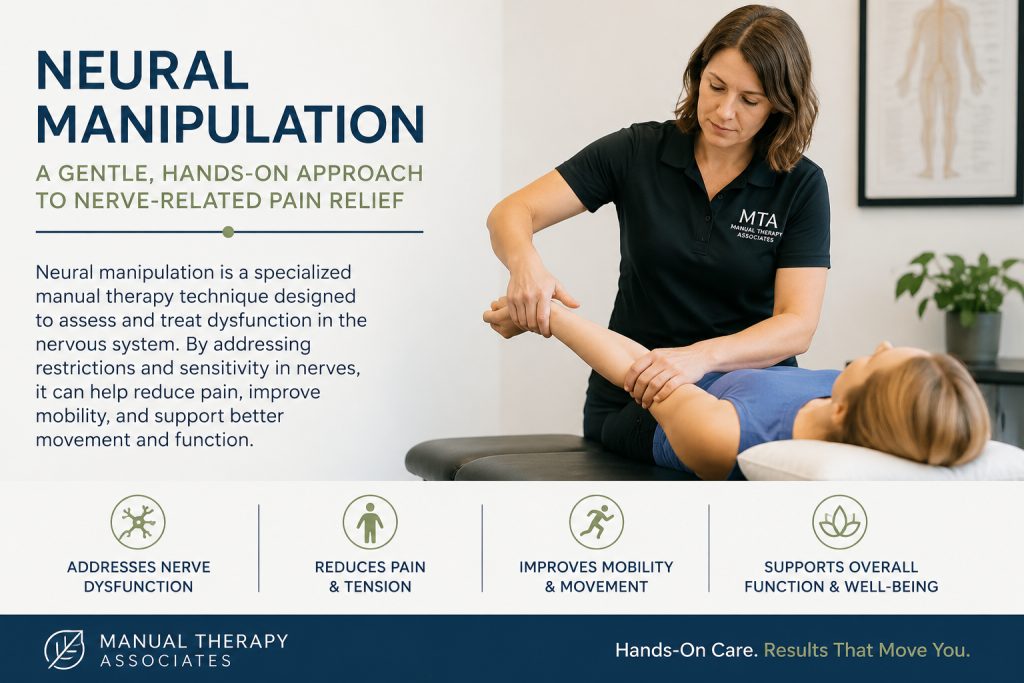
Neural manipulation is a specialized form of manual therapy that uses precise, gentle contact to assess and improve the mobility of nerves and the tissues around them. It is often used alongside physical therapy, myofascial release, joint mobilization, movement retraining, and home exercises when nerve sensitivity or restricted nerve glide may be contributing to pain or limited motion.
Related terms you may see include neural mobilization, nerve mobilization, nerve gliding, neurodynamic techniques, and nerve manipulation. The exact technique depends on the practitioner training, the assessment findings, and how your body responds during treatment.
What makes neural manipulation different?
Neural manipulation focuses specifically on the mechanical relationship between the nervous system and the surrounding tissues. Peripheral nerves travel through tunnels, fascia, muscles, bones, joints, and soft tissue pathways. When those areas lose normal mobility, a nerve may become more sensitive to stretch, pressure, or movement.
Unlike a deep tissue massage that works broadly through muscle tension, neural manipulation is usually lighter and more specific. Unlike a high-velocity joint adjustment, it does not rely on forceful cracking or thrusting. A practitioner uses careful palpation, positioning, and small manual forces to see how a nerve and its related tissues respond.
The Barral Institute describes neural manipulation as a precise manual therapy that helps nerves move freely in relation to nearby muscles, fascia, organs, bones, and tissue pathways. Physical therapy research often uses the term neural mobilization for related nerve-directed manual and movement techniques.
In practice, the best results usually come from integrating neural manipulation with a full physical therapy assessment. Nerve irritation may be only one part of the picture. Joint stiffness, myofascial restriction, posture, breathing patterns, strength, sleep, stress, prior surgery, repetitive work, or old injuries may also influence symptoms.
Why nerve mobility matters
Nerves are not rigid wires. They glide, slide, and adapt as you move. For example, the sciatic nerve needs room to move as you bend, sit, walk, or lift. Nerves in the neck and arm need to glide when you turn your head, reach overhead, type, grip, or sleep with an arm under the pillow.
When a nerve is sensitive, the body may protect the area by tightening muscles or limiting motion. That protection can be helpful at first, but over time it may become part of a pain cycle. The person may move less, tissues may become less adaptable, and the nervous system may stay on alert.
Neural manipulation aims to reduce unnecessary mechanical stress on nerve tissues and improve comfortable movement. The treatment should be specific, gentle, and responsive. More pressure is not always better. In many nerve-related cases, too much stretching or aggressive pressure can flare symptoms instead of calming them.
What does the research say?
The evidence is strongest for the broader category of neural mobilization rather than every named style of neural manipulation. An umbrella review in Physical Therapy Journal reported positive effects of neural mobilization on pain intensity and disability in people with musculoskeletal conditions, while also noting that the quality of evidence was limited and more research is needed.
A 2024 systematic review in PLOS ONE looked at neural mobilisation for peripheral neuropathic pain and found some improvements in nerve-related measures, but the certainty of evidence varied by outcome. In plain language: nerve-focused manual therapy can be a reasonable part of a physical therapy plan for some people, but it should not be sold as a cure-all.
That evidence-aware approach matters. At Manual Therapy Associates, neural manipulation should be used when the assessment suggests it fits the person, not because every pain problem is assumed to be a nerve problem.
7 ways neural manipulation may help nerve-related pain and movement limits
1. It may reduce nerve sensitivity during movement
When a nerve is irritated, everyday movements can feel sharper than expected. Turning the neck, bending forward, reaching, walking, sitting, or straightening a leg may reproduce symptoms. Neural manipulation may help by improving how the nerve and nearby tissues move together, reducing the sense of tugging, pinching, or guarding.
2. It may support sciatica-like symptoms and radiating leg pain
Sciatica-like symptoms can include pain, burning, tingling, or numbness that travels from the low back or hip into the buttock, thigh, calf, or foot. Some people also feel tightness that does not respond well to stretching. When nerve mobility is part of the problem, neural manipulation and carefully dosed nerve gliding may be helpful as part of a broader plan for back and neck pain treatment.
However, radiating leg pain should be assessed carefully. Progressive weakness, loss of bowel or bladder control, numbness in the saddle area, fever, major trauma, or severe worsening symptoms require urgent medical evaluation.
3. It may help neck pain, whiplash patterns, and headache contributors
After a car accident, fall, sports injury, or prolonged posture strain, the neck can become protective. Muscles tighten, joints stiffen, and nerves may become sensitive. Some headaches are influenced by the neck, jaw, upper ribs, or shoulder girdle. Neural manipulation may be used with myofascial release, joint mobilization, and exercise when the assessment shows nerve tension or sensitivity is part of the pattern.
4. It may be useful for arm or hand tingling
Tingling in the arm or hand can have many causes, including neck referral, thoracic outlet patterns, carpal tunnel syndrome, local nerve irritation, repetitive strain, or medical conditions. Neural manipulation does not replace diagnosis, but a manual physical therapy assessment can help identify whether nerve mobility, soft tissue restriction, or posture mechanics may be contributing to symptoms.
5. It may improve mobility after injury, surgery, or scar tissue
Injuries and surgical healing can change how tissues glide. Scar tissue, protective movement habits, swelling history, or long-term inflammation can make an area feel stuck or guarded. Neural manipulation may be combined with scar mobility work, myofascial release, and progressive movement to help restore smoother motion.
6. It may support people with persistent or complex pain
Persistent pain often involves more than one tissue. A person may have joint stiffness, myofascial restrictions, nerve sensitivity, stress-related guarding, decreased strength, and fear of movement at the same time. Neural manipulation can be one tool in a comprehensive plan that helps the body feel safer with movement again.
7. It may make exercise and daily activity feel more comfortable
Manual therapy is often most effective when it helps a person move better afterward. If neural manipulation reduces sensitivity, exercises may feel less threatening and more productive. Your therapist may recommend gentle home movements, nerve glides, breathing strategies, posture changes, or strength work to help the improvement carry over into daily life.
Common symptoms that may warrant a neural manipulation assessment
You may be a candidate for a manual therapy assessment if you notice symptoms such as:
- Radiating pain into the arm, hand, leg, or foot
- Burning, tingling, pins and needles, or electric sensations
- Sciatica-like pain that changes with sitting, bending, walking, or lying down
- Neck pain with headaches, jaw tension, or shoulder symptoms
- Symptoms after whiplash, sports injuries, falls, surgery, or repetitive work
- A feeling of tightness that does not respond well to regular stretching
- Pain that seems connected to movement in another part of the body
You should seek urgent medical care first if you have sudden or progressive weakness, new loss of bowel or bladder control, numbness in the groin or saddle area, unexplained fever, recent major trauma, chest pain, sudden severe headache, unexplained weight loss, or neurological symptoms that are rapidly worsening.
What to expect at Manual Therapy Associates in Arvada
A neural manipulation visit should begin with a conversation, not a technique. Your therapist needs to understand your health history, symptom behavior, goals, prior treatments, and what activities matter most to you.
1. Full-body assessment
Because nerve symptoms can be influenced by distant areas, the assessment may include posture, walking, spinal mobility, limb movement, strength, sensation, reflex-related screening when appropriate, soft tissue restrictions, scar mobility, and neurodynamic testing. The goal is to understand why your body is protecting itself, not simply chase the painful spot.
2. Gentle, specific manual therapy
During neural manipulation, the pressure is typically light to moderate and highly specific. You may feel gentle contact, subtle stretching, small positioning changes, or a sense of tissue release. Treatment should stay within a tolerable range. If symptoms intensify, feel sharp, or linger in a concerning way, tell your therapist immediately so the approach can be adjusted.
3. Integration with manual therapy and movement
Manual Therapy Associates describes manual therapy as a hands-on physical therapy specialty that can include advanced techniques for soft tissues, nerves, and joints. For many patients, neural manipulation works best when it is integrated with myofascial release, joint mobilization, strengthening, mobility exercises, and education about how to move without provoking symptoms.
4. A personalized home plan
Home exercises may include gentle nerve glides, mobility drills, breathing or relaxation strategies, posture changes, strengthening, or activity pacing. Nerve glides should never feel like aggressive stretching. The goal is to nudge the nervous system toward easier movement, not force it through pain.
5. Clear next steps
After the first visit, you should understand what the therapist found, how your symptoms responded, what to do at home, and when to follow up. If your presentation suggests a medical issue outside the scope of manual therapy, the right next step may be referral or coordination with your physician.
Possible side effects of neural manipulation
Most people tolerate gentle neural manipulation well, but temporary responses can happen. Possible side effects include mild soreness, fatigue, temporary symptom awareness, emotional release, or changes in how an area feels for a day or two. These responses should be mild and should settle.
Call your provider or seek medical advice if symptoms worsen significantly, numbness or weakness progresses, pain becomes severe, or you notice new neurological symptoms. Because nerve symptoms can overlap with medical conditions, it is important to communicate clearly and avoid pushing through warning signs.
How long does neural manipulation take to work?
Some people feel a change during the first visit. Others notice gradual improvement over several sessions as the body becomes less protective and movement becomes easier. The timeline depends on how long symptoms have been present, the level of nerve sensitivity, sleep and stress, overall health, prior injuries, and whether the home plan is followed.
A good treatment plan should include measurable goals. Examples include sitting longer with less leg pain, turning the neck with fewer headaches, walking farther without burning symptoms, gripping with less hand tingling, or returning to exercise with more confidence.
Neural manipulation vs. massage, chiropractic, and standard physical therapy
Neural manipulation is not the same as a relaxation massage. It is more specific to nerve mobility and the surrounding tissues. It is also not the same as a high-velocity chiropractic adjustment, because the intent is not to thrust a joint. It can be part of physical therapy when a trained manual therapist uses it within a broader assessment and treatment plan.
The most important question is not which label sounds best. The most important question is whether the practitioner can assess your symptoms, explain the clinical reasoning, treat gently, modify the plan based on your response, and integrate the work into meaningful movement and function.
Is neural manipulation right for everyone?
No single treatment is right for everyone. Neural manipulation may be helpful when nerve mobility, nerve sensitivity, or protective tension appears to be part of the problem. It may not be appropriate, or may need modification, if you have acute infection, unstable medical conditions, recent major trauma, certain vascular conditions, progressive neurological deficits, or symptoms that require urgent medical testing.
This is why the first step is a professional evaluation. If you are unsure, call Manual Therapy Associates and describe your symptoms before scheduling.
Ready to find out whether neural manipulation fits your symptoms?
Manual Therapy Associates serves patients in Arvada and nearby communities such as Wheat Ridge, Westminster, Golden, and Lakewood. If nerve pain, sciatica-like symptoms, headaches, neck pain, arm tingling, or mobility limits are keeping you from the activities you enjoy, a manual therapy assessment can help clarify what may be contributing to the problem.
Call or text 303-668-2898, or use the Schedule Now button on the website to request an appointment at the Arvada office: 12001 W. 63rd Place, Suite 202, Arvada, CO 80004.
FAQs about neural manipulation
Can neural manipulation help chronic pain?
Neural manipulation may help some people with chronic or persistent pain when nerve sensitivity or restricted nerve mobility is part of the overall pattern. Chronic pain is complex, so the best plan usually combines manual therapy, movement, education, strength, pacing, and medical coordination when needed.
Is neural manipulation painful?
It should generally feel gentle and tolerable. Nerve-related symptoms can be sensitive, so your therapist should avoid aggressive pressure or strong stretching that flares symptoms. Always speak up if the treatment feels sharp, overwhelming, or wrong.
Can neural manipulation help sciatica?
It may help sciatica-like symptoms when nerve mobility, tissue restriction, or sensitivity is contributing to radiating leg pain. Because sciatica can have multiple causes, a careful assessment is important before choosing treatment.
Can neural manipulation help headaches?
It may be used when headaches are influenced by neck tension, whiplash patterns, jaw tension, upper rib restrictions, or nerve sensitivity. Some headaches require medical evaluation, especially sudden severe headaches or headaches with neurological symptoms.
Is neural manipulation the same as nerve gliding?
Nerve gliding is often a home or clinic exercise that moves a nerve gently through its pathway. Neural manipulation is broader and may include hands-on assessment, soft tissue work, positioning, and specific manual techniques to improve nerve and tissue mobility.
How many sessions will I need?
The number of sessions varies. Some people feel improvement quickly, while long-standing or complex symptoms may require a longer plan. Your therapist should reassess regularly and adjust the plan based on objective changes and your goals.
Are there side effects?
Temporary soreness, fatigue, or symptom awareness can occur. Significant worsening, progressive numbness, new weakness, or new neurological symptoms should be reported promptly and may require medical evaluation.
Can neural manipulation be combined with other treatments?
Yes. It is often combined with manual therapy, myofascial release, joint mobilization, strengthening, mobility exercises, and education. Combining approaches can be helpful when pain involves multiple tissues and movement habits.
How do I choose a qualified practitioner?
Look for a licensed healthcare professional with advanced manual therapy training, experience with nerve-related pain, clear clinical reasoning, and a willingness to coordinate with your physician when symptoms require medical evaluation.
Do I need a diagnosis before scheduling?
Not always, but you do need an appropriate evaluation. If you have severe, sudden, progressive, or unusual neurological symptoms, contact a medical provider first. For non-urgent symptoms, a manual physical therapy assessment can help determine whether neural manipulation is a good fit.
Medical disclaimer
This article is for educational purposes only and does not replace medical advice, diagnosis, or treatment. Always consult a qualified healthcare professional before starting a new treatment, especially if you have new, severe, progressive, or unexplained symptoms.